
Nitriding
- Home
- Nitriding
Precision Surface Hardening for High-Wear, Low-Distortion Applications
In high-performance industrial environments, components are often subjected to continuous wear, friction, cyclic loads, and corrosive conditions. Conventional hardening methods can introduce distortion, dimensional instability, or excessive brittleness—especially in precision-machined parts. Nitriding and Plasma (Ion) Nitriding heat treatment processes offer an advanced solution by delivering exceptional surface hardness and wear resistance without compromising core strength or dimensional accuracy.
At Infinity Thermotech Solutions Private Limited, we provide precision-controlled Nitriding and Plasma/Ion Nitriding heat treatment services in Pune, helping manufacturers achieve longer component life, improved fatigue strength, and reliable performance in demanding applications.
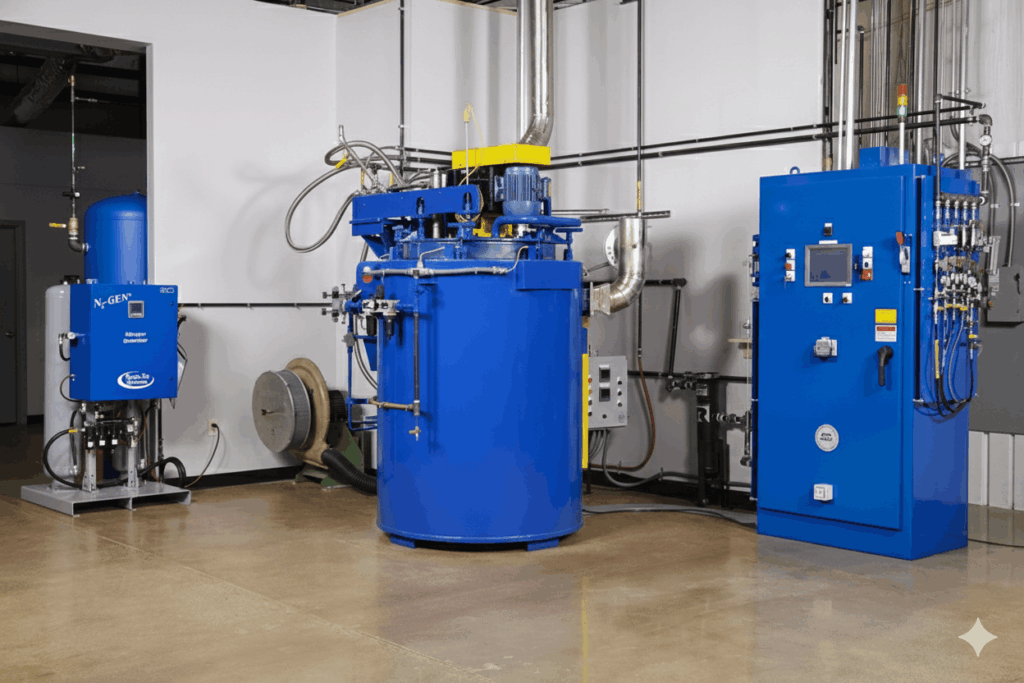
Infinity Thermotech’s Precision Process Control
At Infinity Thermotech, our nitriding and plasma nitriding services are executed with metallurgical precision and strict process discipline, including:
- Controlled gas chemistry and plasma parameters
- Uniform temperature distribution
- Precise control over case depth and hardness
- Optimized cycle times for application-specific performance
Our approach ensures repeatable results, minimal dimensional variation, and compliance with industry specifications.
Understanding the Nitriding & Plasma / Ion Nitriding Process
Conventional Nitriding – Diffusion-Based Surface Hardening
Nitriding is a thermochemical surface hardening process in which nitrogen is diffused into the surface of alloy and low-alloy steels at relatively low temperatures (typically 500–550°C). Unlike carburising or carbonitriding, nitriding does not require quenching, which significantly reduces the risk of distortion.
Plasma / Ion Nitriding – Advanced Controlled Nitriding
Plasma (Ion) Nitriding is an advanced form of nitriding performed in a vacuum chamber using ionized nitrogen gas (plasma). An electrical field accelerates nitrogen ions toward the component surface, enabling precise control over case depth, hardness profile, and compound layer formation.
Applications & Industries Served
Nitriding and plasma nitriding are widely used for components that require high surface hardness with excellent dimensional stability, including:
- Gears and gear shafts
- Crankshafts and camshafts
- Dies, molds, and tooling components
- Hydraulic rods and piston components
- Extrusion screws and barrels
- Fasteners and wear parts
Key Benefits of Nitriding & Plasma / Ion Nitriding
Exceptional Surface Hardness with excellent wear resistance
Minimal Distortion due to low processing temperatures
Improved Fatigue Strength for cyclic load applications
Enhanced Corrosion & Scuffing Resistance
No Quenching Required, preserving dimensional accuracy
Longer Component Life & Reduced Maintenance Costs
Complementary Heat Treatment Services
Infinity Thermotech offers a full spectrum of advanced heat treatment solutions to meet diverse engineering requirements.
For components requiring a hard surface with a tough core and deeper case depth, explore our Carburising Hardening & Tempering services. Where thin, high-hardness surface layers with added corrosion resistance are required, Carbonitriding Hardening & Tempering offers an effective alternative. For oxidation-free, high-hardness treatment of tooling and critical parts, inquire about our Vacuum Heat Treatment capabilities.
Get In Touch
Fill all information details to consult with us to get sevices from us
FAQs About Carbonitriding Hardening & Tempering
Q1. What is the difference between nitriding and plasma nitriding?
Conventional nitriding uses ammonia-based gas diffusion, while plasma nitriding uses ionized nitrogen in a vacuum chamber, offering better control, uniformity, and reduced processing time.
Q2. What materials are suitable for nitriding?
Alloy steels containing elements like chromium, molybdenum, and aluminum are ideal. Common grades include EN41B, EN40B, and nitriding steels.
Q3. Does nitriding cause distortion?
Nitriding causes minimal to negligible distortion because it is performed at lower temperatures and does not require quenching.
Q4. What case depths are achievable with nitriding?
Typical nitrided case depths range from 0.1 mm to 0.7 mm, depending on material and process duration.
Q5. Is post-nitriding tempering required?
No. Nitriding is usually performed on pre-hardened and tempered components, eliminating the need for post-treatment tempering.